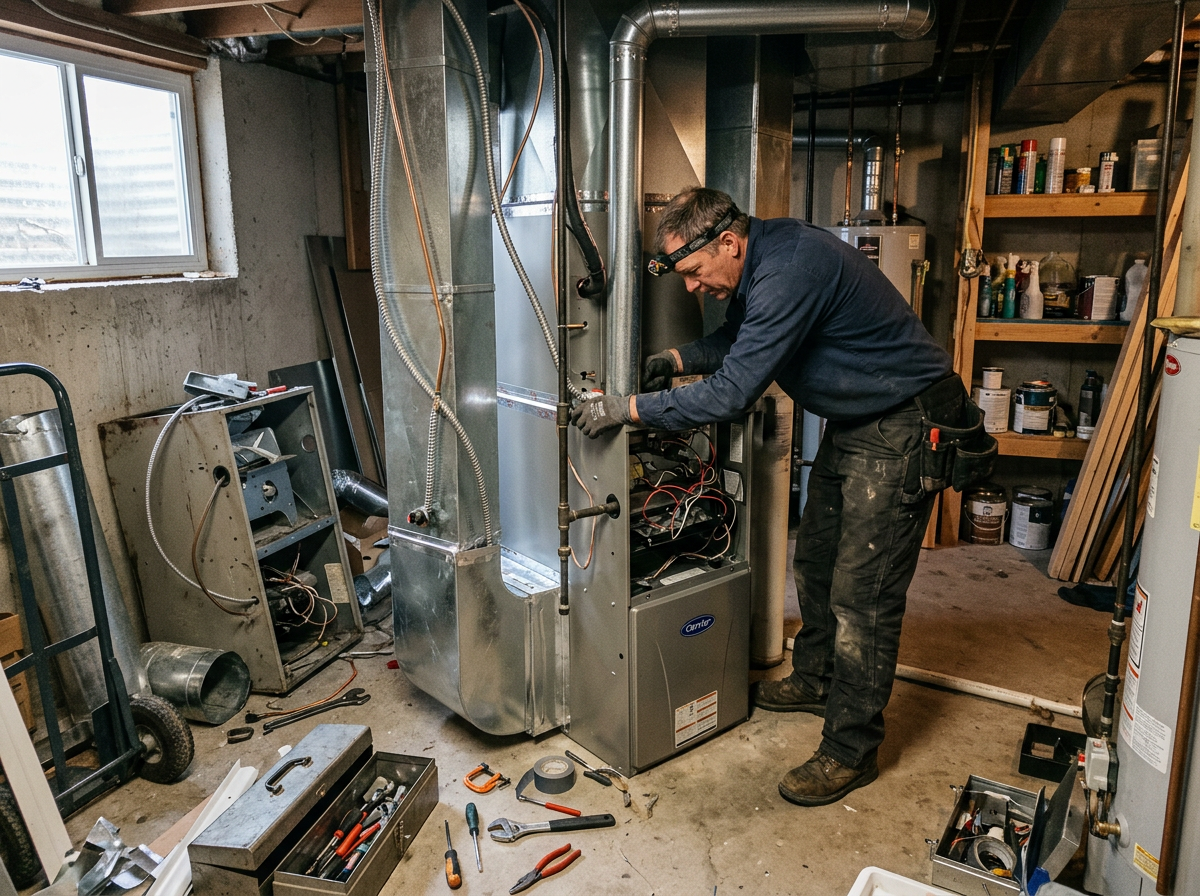
At 6,035 ft elevation, every gas furnace must be derated roughly 4 percent per 1,000 ft above 2,000 ft. This means a 100,000 BTU unit delivers closer to 84,000 BTU without the correct high-altitude orifice kit and pressure adjustments. Combustion air openings and draft hoods also require resizing because thinner air reduces natural draft. Skipping these steps leaves the furnace short on heat and risks incomplete combustion during cold snaps.
Failure modes common here include cracked heat exchangers from repeated 30-40°F daily swings and short cycling caused by oversized equipment in well-insulated Briargate homes. In 1970s Security-Widefield tract houses, undersized return ducts create negative pressure that pulls combustion gases back into living spaces. Technicians begin every replacement by measuring static pressure and temperature rise before removing the old unit so the new furnace matches actual airflow rather than nameplate capacity.
Pre-war homes in Old Colorado City and Old North End often have rigid metal ducts routed through tight joist bays that cannot accept modern high-efficiency furnaces without modification. Newer Wolf Ranch builds may already have two-stage or modulating equipment, but the existing condensate drains and PVC vents frequently need re-sloping for the replacement model. Code requires a permit and inspection on every furnace change-out in El Paso County; the job is not complete until the unit passes combustion analysis and CO testing.
Technicians always verify that the new furnace shares the same footprint or plan for transition plenums, because moving the unit even six inches can force expensive duct rework in Cimarron Hills crawlspaces. Humidification is added only when the homeowner requests it, since Colorado Springs air is already very dry and most replacements focus first on reliable heat delivery and proper venting.
Technician insight
In Colorado Springs the thing that catches most people out with Furnace Replacement is the ductwork in 1970s Security-Widefield homes. Those returns are often undersized for the higher-static-pressure blowers on new furnaces, so we end up enlarging the return or adding a filter base or the unit short-cycles all winter.
Cimarron Hills 1982 furnace replacement
The existing unit short-cycled during chinook winds and showed elevated CO on the heat exchanger. Measurements revealed the return was 20 percent undersized for the new two-stage blower. We enlarged the return trunk, installed a 96 percent furnace with the correct high-altitude kit, and verified temperature rise and combustion numbers before the county inspection.
Furnace Replacement Services We Offer
✓High Altitude Furnace Derating and Kit Installation
Select and install the correct orifice and conversion kit so the furnace maintains rated output and safe combustion at 6,035 ft.
✓Old Home Duct Adaptation
Modify rigid metal runs in pre-war Old Colorado City and Old North End houses to fit new furnace dimensions without airflow loss.
✓New Construction Furnace Upgrade
Replace single-stage units in Briargate and Wolf Ranch homes with two-stage or modulating models while reusing existing PVC venting.
✓Tract Home Furnace Swap
Direct replacement in 1970s-80s Security-Widefield and Cimarron Hills homes, including return-air and filter-base upgrades.
✓Condensate Drain and Vent Reconfiguration
Re-slope drains and extend or reroute PVC vents to meet current code on high-efficiency furnace replacements.
Furnace Replacement Cost in Colorado Springs, CO
| Service | Typical Range | What Affects It |
|---|---|---|
| Standard 80% furnace replacement | $3,800–$5,200 | Single-stage unit in tract homes with minimal duct work |
| High-efficiency 95%+ replacement | $4,900–$7,100 | Includes condensate drain and PVC venting changes |
| High-altitude kit and derating labor | $350–$650 | Orifice, springs, and manifold pressure adjustment |
| Duct modification or transition plenums | $800–$2,400 | Required in older homes with mismatched footprints |
Ranges are typical for Colorado Springs, CO and confirmed with an exact written quote before any work starts.
How it works
- 1
Load Calculation and Altitude Review
Measure the home, note insulation and window changes, then apply the 4 percent per 1,000 ft derating factor to size the replacement furnace correctly.
- 2
Duct and Combustion Air Inspection
Check static pressure, return-air sizing, and combustion air openings before removal so the new unit will not create negative pressure or venting problems.
- 3
Old Unit Removal and Site Prep
Disconnect gas, electric, and venting, then protect flooring and create a safe path for the new furnace through narrow hallways or crawlspace access.
- 4
New Furnace Set and Connections
Position the unit, install the high-altitude kit, connect gas, electric, condensate, and venting, then perform combustion analysis before startup.
- 5
Final Testing and Homeowner Walkthrough
Verify temperature rise, CO levels, and thermostat operation, then show the homeowner filter location and basic maintenance steps.
Pricing
Pricing varies by furnace efficiency, home age, and required duct or venting changes; most replacements fall in the mid-four to low-five figure range.