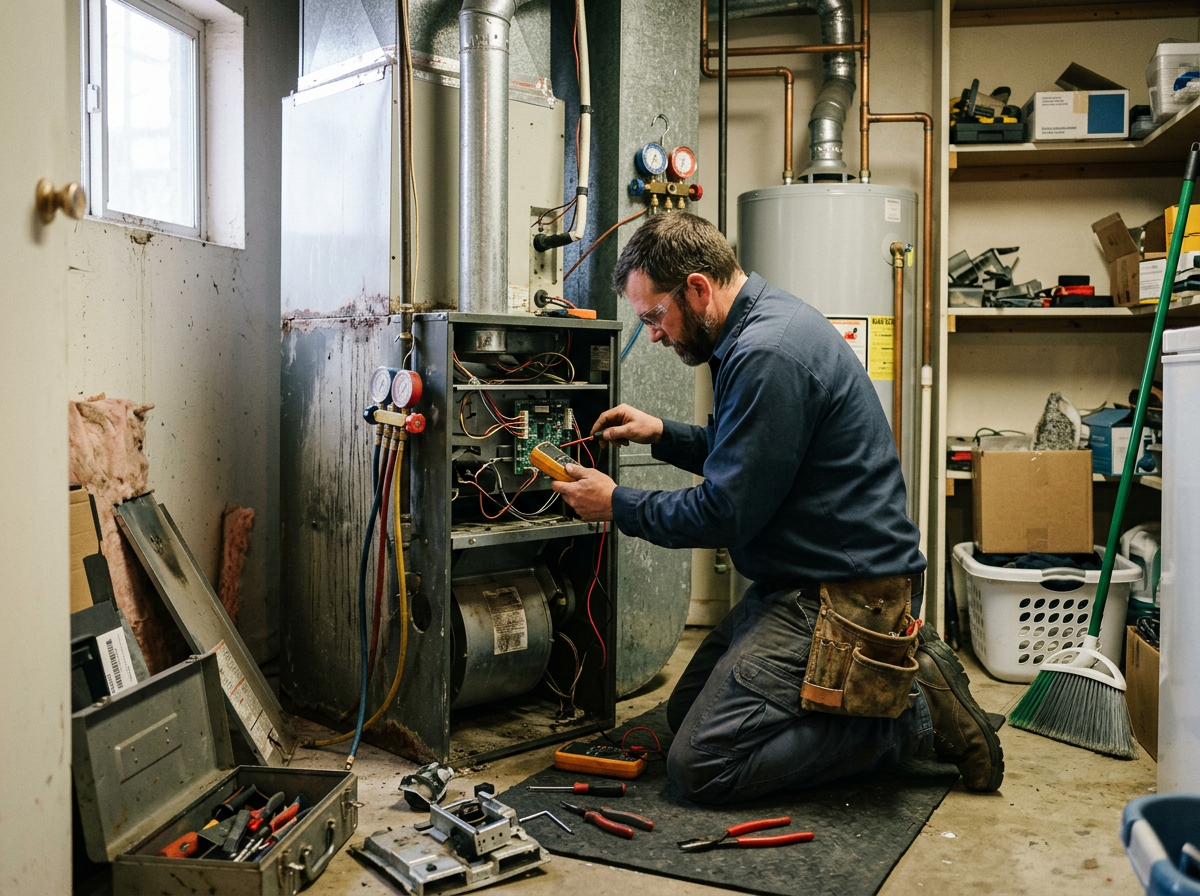
At 6,035 feet, gas furnaces lose roughly four percent output per thousand feet above two thousand, so a unit sized for sea level often short-cycles or fails to reach setpoint once combustion air thins and orifices are not swapped for high-altitude kits. Technicians first verify gas pressure, then check draft and combustion-air openings before touching the heat exchanger. Pre-war homes in Old North End and Old Colorado City add another layer because rigid metal ducts were routed through tight crawl spaces that now trap heat and accelerate exchanger cracks during 30-degree daily swings.
Hail season in El Paso County leaves condenser fins flattened, which raises head pressure and trips high-pressure switches on the hottest afternoons. A quick visual check of the outdoor coil is followed by a static-pressure test across the evaporator to confirm airflow before any refrigerant is touched. In tract homes built in the 1970s and 1980s in Security-Widefield and Cimarron Hills, undersized returns compound the problem, so repairs often include enlarging the return or adding a second filter grille rather than simply recharging the system.
Chinook winds can drop outdoor temperatures thirty degrees in an hour, causing heat pumps to short-cycle and trip breakers. The diagnostic sequence starts with confirming the thermostat call, then reading voltage at the contactor and checking the defrost board timing. Newer high-efficiency homes in Briargate and Wolf Ranch use variable-speed equipment that needs the correct dip-switch settings for 7,000-plus-foot operation; missing those settings is a common reason units lock out on cold mornings.
Dry winter air below 20 percent relative humidity drives homeowners to run portable humidifiers that oversaturate the return plenum and corrode limit switches. During an emergency call the technician measures static pressure before and after the coil, inspects the condensate drain for ice, and verifies that the inducer motor is not pulling excess amperage due to altitude-reduced cooling. These steps prevent repeat failures that would otherwise occur the next time temperatures swing.
Technician insight
In Colorado Springs the thing that catches most people out with Emergency HVAC Repair is the combination of 1970s-80s ductwork in Security-Widefield and Cimarron Hills plus the four-percent derate at 6,035 feet. Homeowners replace the igniter or capacitor only to have the same unit short-cycle again because the return is undersized and the orifice was never changed. Checking static pressure and combustion air first usually reveals the real fix.
No-heat call on a 35-degree morning in Manitou Springs
A 1987 furnace in a Manitou Springs home at 6,412 feet would not stay lit. Static pressure was high and combustion air was restricted by a blocked intake in the crawl space. The technician opened the intake, swapped the orifice for the correct high-altitude size, and reset the limit switch. The furnace held temperature through the next chinook swing without further trips.
Emergency HVAC Repair Services We Offer
✓No-Heat Furnace Repair
Restores ignition and airflow on high-altitude gas furnaces that fail to light or short-cycle when orifices and combustion air are not adjusted for 6,000-plus feet.
✓AC Not Cooling Repair
Addresses hail-damaged condenser coils, high head pressure, and low airflow in systems serving older tract homes with undersized returns.
✓Heat Pump Short-Cycle Repair
Corrects rapid on-off cycling caused by chinook winds and improper defrost settings on variable-speed units installed above 6,000 feet.
✓Thermostat and Control Failure
Replaces or rewires thermostats and control boards that lose calibration during 30-degree daily temperature swings common in Colorado Springs.
✓Condenser Hail Damage Assessment
Straightens fins, checks high-pressure switches, and restores cooling capacity after spring hail storms flatten outdoor coils.
✓Emergency Duct and Airflow Repair
Locates collapsed or disconnected ducts in pre-war homes and restores proper static pressure so the system can meet load at altitude.
Emergency HVAC Repair Cost in Colorado Springs, CO
| Service | Typical Range | What Affects It |
|---|---|---|
| After-hours diagnostic visit | $129–$189 | Waived when repair is completed same call |
| Ignition or control board replacement | $350–$650 | Parts vary by furnace model and altitude kit needs |
| Condenser coil repair after hail | $275–$550 | Fin straightening versus full coil replacement |
| Heat pump defrost board or sensor | $225–$475 | Includes re-setting for local elevation |
| Duct reconnection or return enlargement | $300–$700 | Depends on access in older homes |
Ranges are typical for Colorado Springs, CO and confirmed with an exact written quote before any work starts.
How it works
- 1
Dispatch And Symptom Intake
Technician gathers model, age, and exact symptoms while en route so the correct high-altitude parts can be staged on the truck.
- 2
On-Site Safety And Power Check
Power is isolated, gas is shut off if combustion issues are suspected, and carbon-monoxide levels are read before any further testing.
- 3
Altitude-Specific Diagnostics
Gas pressure, orifice size, combustion air, and static pressure are measured against local elevation tables before components are replaced.
- 4
Repair And Function Test
Parts are installed, the system is run through a full cycle, and temperature split plus draft are verified under current outdoor conditions.
- 5
Homeowner Walk-Through
Owner is shown the failed part, advised on any altitude-related maintenance, and given a written summary before the technician leaves.
Pricing
Emergency rates apply outside normal business hours; diagnostic fee is credited toward any repair performed the same visit.