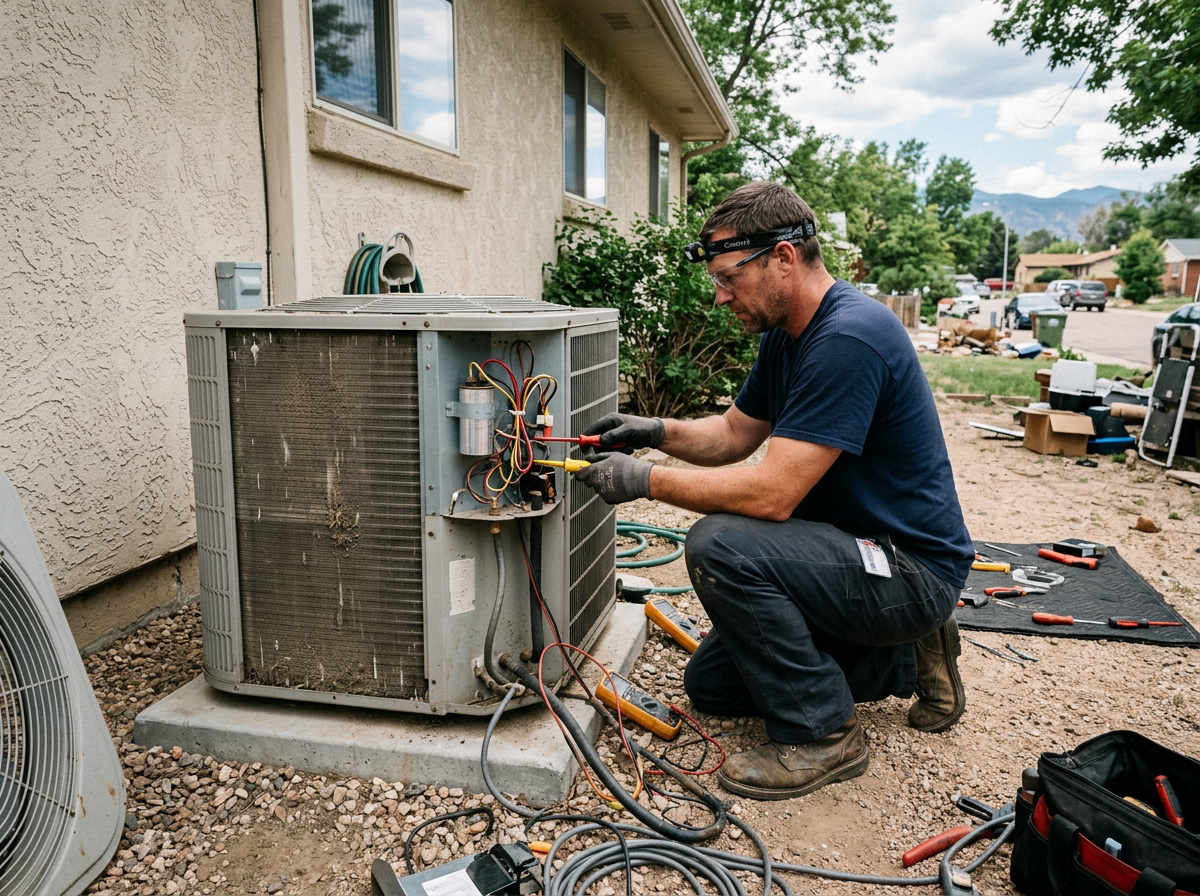
Colorado Springs AC units face repeated hail impacts that flatten condenser fins and raise head pressure, forcing the compressor to work harder in thin air at 6,035 ft. Daily 30-40°F swings between morning and afternoon trigger short cycling that stresses contactors and capacitors in both 1970s Security-Widefield tract homes and newer Briargate builds. Technicians start diagnostics by checking static pressure, superheat, and subcooling before touching electrical components, because altitude reduces air density and changes how coils reject heat.
Refrigerant leaks often appear first at flare fittings or Schrader valves after thermal expansion from chinook winds. A full sequence includes visual inspection of the outdoor unit for dented fins, meg-testing the compressor windings, and verifying that the indoor blower is moving the correct CFM through older hard-ducted systems in Old Colorado City. Skipping the fin-straightening step after hail leaves the system running at elevated pressures that shorten equipment life.
High-altitude conditions also affect TXV or orifice performance, so technicians carry conversion charts and adjust charge weights rather than using sea-level targets. In pre-war homes with tight mechanical rooms, restricted combustion air paths can indirectly impact dual-fuel setups even when the AC side is running. Replacement parts must match the derated capacity; using an off-the-shelf capacitor without confirming run-load amps leads to repeated callbacks during the next heat wave.
Homeowners in Monument and Woodland Park at higher elevations often see earlier compressor failures because the same unit moves less heat. Proper repair always includes cleaning the evaporator drain to prevent moisture issues in the extremely dry local air and confirming that the thermostat anticipator setting matches the short-cycle pattern caused by rapid temperature changes.
Technician insight
In Colorado Springs the thing that catches most people out with AC repair is hail-flattened fins on condensers in Security-Widefield and Cimarron Hills tract homes. Homeowners notice weak cooling but miss that the raised head pressure is slowly cooking the compressor, especially when 30-40 degree swings keep the unit short-cycling all week.
Hail-Damaged Unit in Briargate
A Briargate homeowner reported weak airflow and frequent short cycling after a spring storm. Inspection showed flattened condenser fins and elevated head pressure from the hail impact. We straightened the fins, replaced the run capacitor stressed by repeated cycling, and adjusted the charge for local altitude. The system stabilized and maintained even temperatures through the next heat wave.
AC Repair Services We Offer
✓Capacitor Replacement
Restore starting torque and prevent hard-start damage after temperature swings stress the run capacitor in local units.
✓Condenser Fin Repair
Straighten hail-flattened fins and restore airflow to lower head pressure on Colorado Springs rooftops and ground pads.
✓Refrigerant Leak Detection and Repair
Locate leaks at coils or fittings caused by expansion from daily temperature swings and recharge to altitude-adjusted specs.
✓Compressor Diagnosis
Meg-test windings and check pressures to determine if short cycling from chinook winds has damaged the compressor.
✓Thermostat and Control Calibration
Adjust anticipator settings and cycle rates to stop short cycling triggered by rapid 30-40°F swings common in El Paso County.
✓Evaporator Coil Cleaning
Remove dirt buildup that reduces efficiency in dry Colorado Springs air and prevents freeze-ups during shoulder seasons.
AC Repair Cost in Colorado Springs, CO
| Service | Typical Range | What Affects It |
|---|---|---|
| Diagnostic Visit | $95–$150 | Includes pressures, electrical checks, and written report; waived if repair approved same day. |
| Capacitor Replacement | $180–$320 | Varies by dual-run vs single and access on roof or pad units. |
| Condenser Fin Straightening | $150–$275 | Depends on extent of hail damage and whether chemical cleaning follows. |
| Refrigerant Leak Repair | $350–$850 | Includes leak search, repair, and recharge; larger coils or hard-to-reach lines increase cost. |
| Compressor Replacement | $1,400–$2,600 | Price moves with unit tonnage, whether the system is R-22 or 410A, and disposal fees. |
Ranges are typical for Colorado Springs, CO and confirmed with an exact written quote before any work starts.
How it works
- 1
On-Site Assessment
Technician inspects the outdoor unit for hail damage, measures pressures, and reviews recent short-cycle history before any disassembly.
- 2
Electrical And Mechanical Testing
Check capacitors, contactors, and compressor amperage while confirming blower performance through the existing duct system.
- 3
Component Repair Or Replacement
Straighten fins, replace failed parts, and adjust refrigerant charge using altitude-corrected targets rather than standard charts.
- 4
System Verification
Run the unit through multiple cycles, confirm superheat and subcooling, and document temperature split across the evaporator.
- 5
Final Walkthrough
Explain findings, show repaired areas, and provide maintenance steps tailored to local weather patterns.
Pricing
Most AC repairs fall into diagnostic plus parts ranges; larger compressor or coil work moves into the upper end.