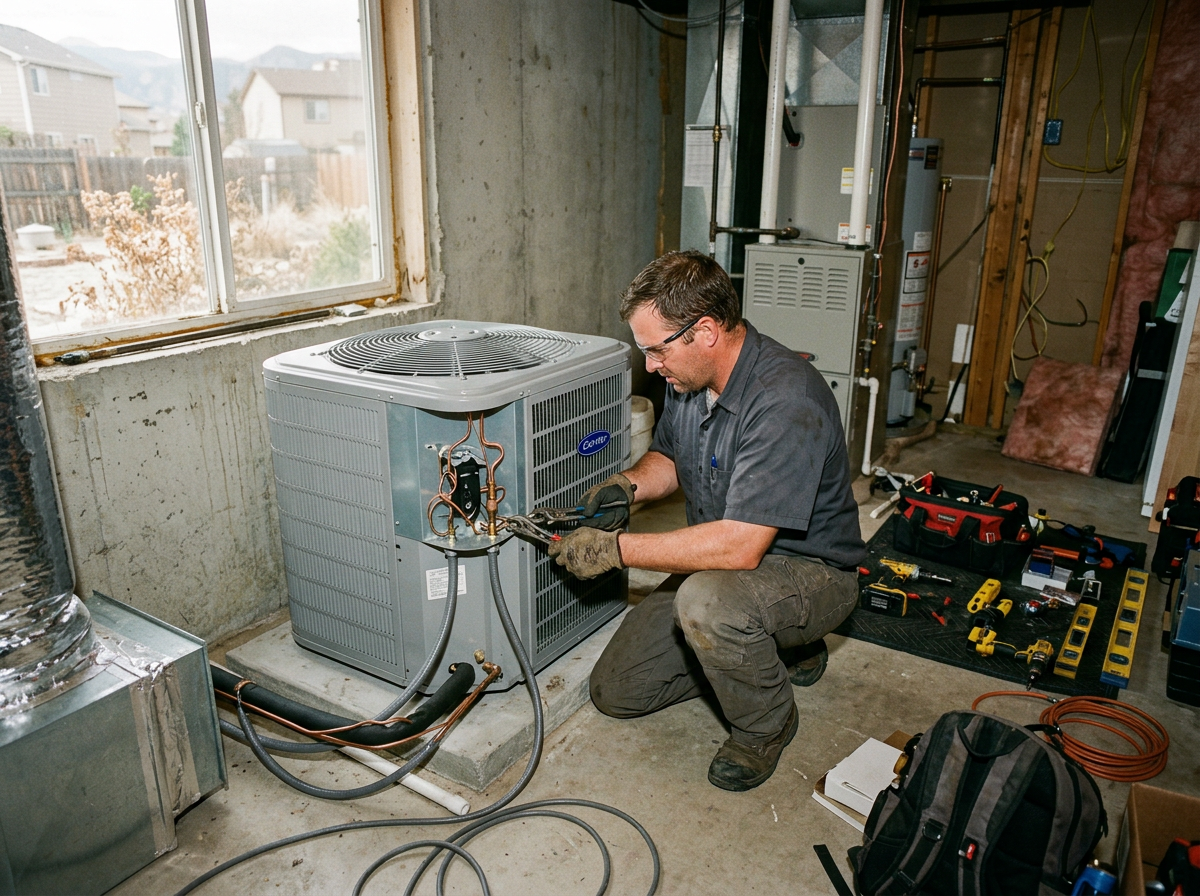
At 6,035 feet, air density drops roughly 20 percent, lowering an air conditioner’s sensible cooling capacity and changing the required equipment sizing. We run a Manual J load calculation that incorporates local design temperatures, the home’s insulation, window orientation, and the specific elevation before selecting tonnage. Undersized units short-cycle during the rapid 30-40°F afternoon drops common here, while oversized units never dehumidify properly in the dry climate.
El Paso County hail frequently flattens condenser fins and raises head pressure, so we install hail guards or louvered enclosures on every outdoor unit and position them on the north or east side of the house when possible. In older Security-Widefield and Cimarron Hills tract homes we often find undersized or poorly routed return ducts that must be corrected during installation to maintain proper static pressure. Newer Briargate builds usually allow easier placement but still require condensate lines sloped for the dry air to prevent evaporation before the drain reaches the sewer.
We pull existing linesets only when they are the wrong diameter or show oil residue indicating burnout, otherwise we flush and reuse to limit wall damage. High-efficiency variable-speed systems are matched to the home’s duct design so the blower can handle the thinner air without exceeding motor limits. Every installation includes a new thermostat with outdoor sensor to manage the wide daily swings and prevent unnecessary runtime.
Pre-war homes in Old North End and Old Colorado City often have rigid metal ducts routed through tight joist bays; we measure each run and may add a small return in a central hallway to balance the system. Final commissioning includes checking superheat and subcooling at the actual elevation because factory charts assume sea level.
Technician insight
In Colorado Springs the thing that catches most people out with Air Conditioning Installation is skipping the altitude-adjusted load calculation, so units sized at sea-level charts short-cycle during the big afternoon drops and never reach proper humidity removal in our dry air.
Briargate Two-Story With Undersized Return
Homeowner reported short cycling on a recently installed 4-ton unit. We found the original return was sized for sea level and the variable-speed blower was hitting limit. We added a second return in the upstairs hallway, adjusted static pressure, and re-commissioned at 6,035 ft. The system now runs longer cycles and maintains 45-48 percent relative humidity.
Air Conditioning Installation Services We Offer
✓Central Air Conditioning Installation
Full split-system installation sized for 6,035 ft elevation with hail-protected condenser and new programmable thermostat.
✓Ductless Mini-Split Installation
Multi-zone or single-zone systems ideal for additions or homes with difficult duct routing in Old Colorado City and Manitou Springs.
✓High-Efficiency AC Replacement
Upgrade from older 10-13 SEER units to variable-speed models that better handle rapid temperature swings and reduce short cycling.
✓Whole-Home AC with Humidifier Integration
Installation that adds a whole-house humidifier to offset the extremely dry Colorado Springs air while providing cooling.
✓Evaporative Cooler to Refrigerant AC Conversion
Removal of swamp coolers and installation of sealed refrigerant systems suited to modern insulation levels in newer Briargate homes.
Air Conditioning Installation Cost in Colorado Springs, CO
| Service | Typical Range | What Affects It |
|---|---|---|
| Central AC Installation (3-ton) | $5,200–$7,800 | Includes standard lineset and thermostat; higher for variable-speed or duct changes |
| Ductless Mini-Split (2-zone) | $4,800–$6,900 | Price rises with additional heads or long line runs in multi-level homes |
| Hail Guard Addition | $180–$320 | Required on most exposed pads in El Paso County |
| Duct Modification Or Return Addition | $650–$1,400 | Common in 1970s-80s tract homes with undersized returns |
Ranges are typical for Colorado Springs, CO and confirmed with an exact written quote before any work starts.
How it works
- 1
Site Evaluation And Load Calculation
We measure the home, note insulation, window exposure, and elevation, then run a Manual J at altitude to determine exact tonnage needed.
- 2
Equipment Selection And Placement
Choose a unit with proper SEER and features, then locate the condenser to minimize hail exposure and line-set length.
- 3
Ductwork And Electrical Preparation
Modify or extend ducts as required, verify electrical service, and install a new disconnect and condensate drain with proper pitch.
- 4
Installation And Commissioning
Set the new indoor and outdoor units, pressure test, pull vacuum, charge to spec, then verify superheat, subcooling, and airflow at local conditions.
- 5
Customer Walkthrough
Demonstrate thermostat operation, explain filter changes, and provide maintenance schedule tailored to hail season and dry air.
Pricing
Pricing varies by home size, efficiency rating, and whether duct modifications or electrical upgrades are required.